At 6:30, just as the shelter lights were about to dim, that old dog seemed to realize no one was coming for him.
I know that sounds dramatic.
But I was there, standing near the last row of kennels with my purse still on my shoulder, and I saw something in him change.
He stopped watching the door.
I had only come in to drop off a bag of dog food and a few old blankets. That was all. I had already convinced myself I was too busy, too tired to take on another responsibility—another life that might depend on me.
I was fifty-one, living alone, working too much, and I had become very good at calling my life “peaceful” when what I really meant was quiet.
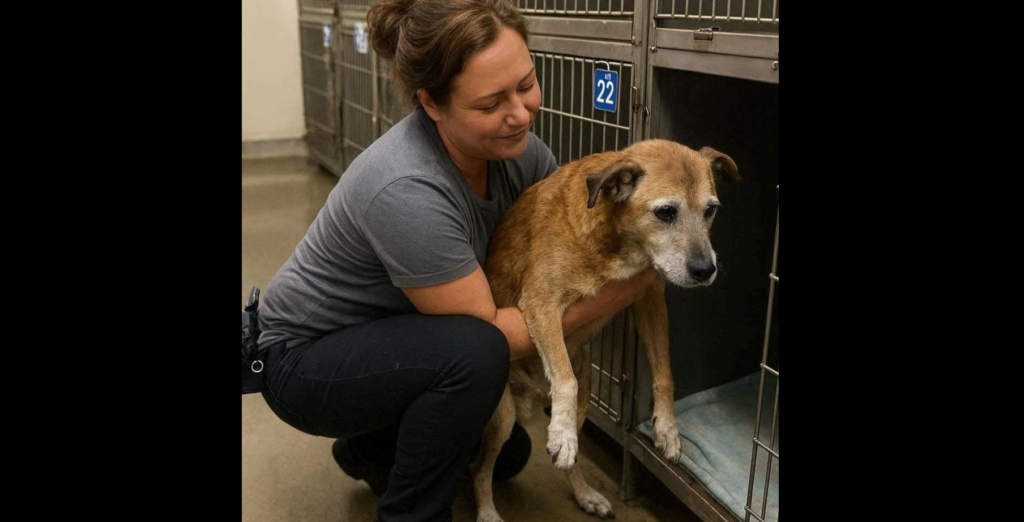
The dog was in the bottom kennel at the very end.
Not like the puppies up front with bright eyes, wagging tails, and signs that said things like FRIENDLY or GREAT WITH KIDS. He was older. Thin. Gray around the muzzle in a way that made him look more worn than anything else. One ear slightly bent. His coat a bit rough. His movements slow and stiff.
His name was Oliver.
And in bold letters on his card was a single word: senior.
A staff member came over and said, “He’s been here about three weeks.”
I asked what happened.
She lowered her voice the way people do when the story isn’t a good one.
“His owner went into a nursing home. The family said they needed a few days to figure things out. They said they’d come back for him.”
She paused.
“They didn’t.”
I looked at Oliver again.
He wasn’t barking. That was the hardest part. The room was loud—dogs jumping, whining, scratching at the doors. Puppies pressing against the bars, desperate to be noticed.
Oliver just sat there.
Like he had already asked the question too many times and didn’t want the answer anymore.
I crouched down.
He lifted his head and looked at me—not with excitement, not even with hope, but with a quiet attention that hurt more than begging ever could.
“Has anyone asked about him?” I said.
The woman gave a small, sad smile.
“People want young. Or easy. Older dogs that need patience… they get overlooked.”
I’ll admit something I’m not proud of.
For a moment, I almost nodded like that made sense.
Because in a way, it does. People are drawn to what’s simple, what’s new—what doesn’t remind them how quickly time passes. We do it with everything—things, decisions… even relationships.
Then the lights dimmed.
Oliver turned his head toward the front door.
Not quickly. Not hopefully. Just out of habit.
No one came.
Something in my chest tightened so suddenly it almost felt like anger.
Not at anyone in particular—just at how unfair it is that a dog can give years of loyalty, lose everything in an instant, and then be passed over because he’s no longer “easy.”
“Can I take him out?” I asked.
The staff member opened the kennel.
Oliver didn’t resist when I lifted him. He was lighter than I expected. I had prepared myself for fear, for stiffness… maybe even a snap.
But the moment I held him, he relaxed.
Not completely—but enough.
Like he had been holding himself together for so long that when someone finally said, “I’ve got you,” he allowed himself to believe it, just a little.
He rested his head against me.
That was all it took.
I didn’t go home to think about it. I didn’t call anyone. I didn’t make a list of pros and cons. I stood there with that old dog leaning into me while they brought out the paperwork.
On the drive home, he stayed quiet in the crate beside me.
I talked the whole way.
I told him my house was small. That I drank too much coffee and stayed up late watching old shows. That I wasn’t perfect. That I didn’t really know what I was doing.
When we got home, he stepped out slowly, looking around as if he wasn’t sure this place was real.
He sniffed the floor. Checked the corners. Stood still for a long moment.
Then he slipped behind the couch.
I sat on the floor and waited.
An hour passed. Then two.
I started to wonder if I had made a mistake. Maybe everything was too much for him. Maybe he missed the only home he had ever known. Maybe love, when it comes late, feels unfamiliar… even a little frightening.
That night, sometime around two in the morning, I woke up.
Oliver was standing beside my bed.
He wasn’t whining. Wasn’t trying to climb up. Just standing there, watching me in the dark.
I pulled the blanket back slightly and whispered, “Hey, buddy.”
He blinked.
And somehow, I understood.
He wasn’t checking the room.
He was checking me.
Making sure I was still there.
That I hadn’t disappeared too.
So I reached down and rested my hand on his back.
“I’m not going anywhere,” I said.
He paused for a second.
Then he leaned into my hand.
I felt his body soften, and for the first time, his tail gave a slow, gentle wag.
I cried right there in the dark.
Not because I had rescued him.
But because I finally understood something I hadn’t allowed myself to feel in a long time.
Taking in an older dog isn’t just about giving them a place to stay.
It’s about earning the trust of a heart that has every reason to be cautious.
People say I saved Oliver.
Maybe I did.
But every night, when he curls up close enough to know I’m still there, I realize he gave something back too.
A kind of warmth I didn’t even realize I had lost.
And now I know this—
No one is too old to be chosen.
No one is too worn down to be loved.
And sometimes, the ones who have been waiting the longest… are the ones who love the deepest.
Now, when the lights go out at night, Oliver doesn’t watch the door anymore.
He just comes and lies beside me.
Like he finally understands—
someone stayed.